















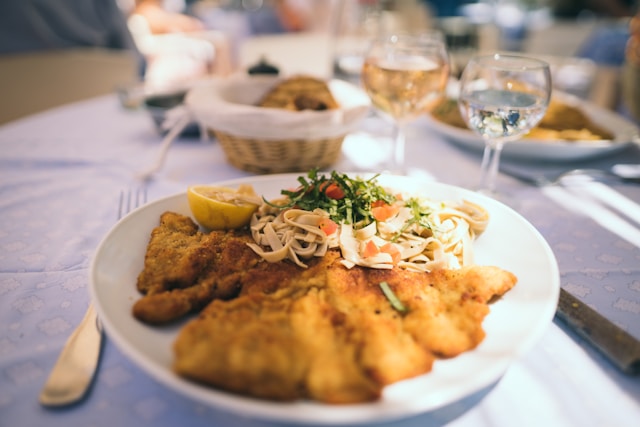
There are few foods as gloriously uncomplicated as schnitzel. Take a thin cutlet, flatten it until it has serious personal-space issues, coat it in breadcrumbs, fry it until golden, and serve it with something potato-related. Simple? Yes. Easy to do brilliantly? Absolutely not.
The best schnitzels have that magical crrrrunch followed by tender meat, airy breading and just enough lemon to make you wonder why you ever ordered anything else.
From Vienna’s legendary Wiener Schnitzel to German pork schnitzels and Australian interpretations, here are 20 of the best schnitzel places around the world worth putting on your culinary itinerary.
1. Figlmüller at Wollzeile — Vienna, Austria
Founded: 1905
Address: Wollzeile 5, 1010 Vienna, Austria
Types of Meat Used: Veal; famous house version uses pork
Breading Technique: Flour, egg and breadcrumbs; pounded exceptionally thin
Frying Medium: Lard and oil for the traditional veal version
Traditional Sides: Potato salad, lemon
Garnishing: Lemon wedge; parsley depending on preparation
Cost for Two: Approx. €50–€65
Instagram: @figlmueller on Instagram
Website: Figlmüller official website
Figlmüller’s story began in 1905 when Johann Figlmüller opened a wine tavern behind St. Stephen’s Cathedral. More than a century later, the family name is practically synonymous with oversized Viennese schnitzel. Its legendary house schnitzel is pork, while the genuine Wiener Schnitzel is veal. The portions are famously enormous, thin and plate-defying. Basically, schnitzel with ambitions.
2. Restaurant Meissl & Schadn Wien — Vienna, Austria
Founded: Modern restaurant opened in the 2010s; the Meissl & Schadn name has older Viennese roots
Address: Schubertring 10–12, 1010 Vienna
Types of Meat Used: Veal
Breading Technique: Hand-beaten egg and artisanal breadcrumbs
Frying Medium: Clarified butter, lard or vegetable oil
Traditional Sides: Potato salad, cucumber salad, parsley potatoes
Garnishing: Lemon, parsley, shallot, capers, egg and anchovy
Cost for Two: Approx. €60–€75
Instagram: @meisslundschadn on Instagram
Website: Meissl & Schadn official website
Meissl & Schadn treats schnitzel almost like theatre—and honestly, we’re here for it. Its open kitchen lets diners watch the meat being pounded, breaded and fried. The restaurant insists that authentic Wiener Schnitzel means veal, while diners can choose between clarified butter, lard or vegetable oil. Add the traditional Viennese garnish and you’ve got edible Austria in one plate.
3. Plachutta Wollzeile — Vienna, Austria
Founded: 1993 at the Wollzeile location
Address: Wollzeile, 1010 Vienna, Austria
Types of Meat Used: Veal
Breading Technique: Classic flour–egg–breadcrumb coating
Frying Medium: Traditional frying fat/oil
Traditional Sides: Potato salad, parsley potatoes
Garnishing: Lemon and parsley
Cost for Two: Approx. €55–€70
Instagram: @plachutta_wien on Instagram
Website: Plachutta official website
Plachutta may be famous for tafelspitz, but its schnitzel deserves its own standing ovation. The Wollzeile restaurant opened in 1993 and became part of the family’s expanding Viennese restaurant empire. Here, quality veal is carefully pounded and breaded before becoming crisp and golden. It is traditional Vienna without needing a time machine—or a waistcoat.
4. Schnitzelwirt — Vienna, Austria
Founded: Mid-20th century Viennese schnitzel institution
Address: Neubaugasse 52, 1070 Vienna
Types of Meat Used: Pork, veal and chicken
Breading Technique: Traditional flour, egg and breadcrumbs
Frying Medium: Hot frying oil
Traditional Sides: Potato salad, mixed salad, fries
Garnishing: Lemon
Cost for Two: Approx. €25–€40
Instagram: Schnitzelwirt Instagram
Website: Schnitzelwirt information page
If Figlmüller is schnitzel theatre, Schnitzelwirt is schnitzel street culture. The Neubaugasse institution is famous for generous portions, wallet-friendly prices and queues that suggest Vienna collectively received the same dinner memo. Multiple meats and preparations make this a particularly fun stop for indecisive eaters. Come hungry, leave happy, and perhaps loosen your belt beforehand.
5. Zum Alten Fassl — Vienna, Austria
Founded: Established for decades as a traditional Viennese Beisl
Address: Ziegelofengasse 37, 1050 Vienna
Types of Meat Used: Veal and pork
Breading Technique: Classic Austrian breadcrumb coating
Frying Medium: Traditional frying fat
Traditional Sides: Potato–lamb’s lettuce salad
Garnishing: Lemon, pumpkin-seed oil or lingonberries
Cost for Two: Approx. €50–€60
Instagram: Zum Alten Fassl Instagram
Website: Zum Alten Fassl official website
Zum Alten Fassl is the sort of Viennese restaurant where the schnitzel arrives with a side order of atmosphere. This long-running Beisl is known for traditional Austrian cooking and once counted musician Falco among its regulars. Its veal Wiener Schnitzel comes with potato and lamb’s lettuce salad, while pork schnitzel offers a cheaper, equally comforting alternative.
6. Zur letzten Instanz — Berlin, Germany
Founded: 1621
Address: Waisenstraße 14–16, 10179 Berlin
Types of Meat Used: Pork and veal, depending on menu
Breading Technique: German-style breadcrumb crust
Frying Medium: Pan-fried
Traditional Sides: Potato dishes, vegetables, cabbage
Garnishing: Herbs and sauce depending on style
Cost for Two: Approx. €55–€75
Instagram: @zurletzteninstanz on Instagram
Website: Zur letzten Instanz official website
History comes heavily seasoned at Zur letzten Instanz. The restaurant traces its gastronomic tradition to 1621 and is recognised as Berlin’s oldest restaurant. The current restaurant has occupied the site since 1924 and was rebuilt after wartime destruction. Its cuisine focuses on Berlin classics and regional ingredients, making it an atmospheric place to experience schnitzel alongside centuries of stories.
7. Zeughauskeller — Zurich, Switzerland
Founded: 1926
Address: Bahnhofstrasse 28a, 8001 Zurich
Types of Meat Used: Veal
Breading Technique: Traditional breadcrumb coating
Frying Medium: Pan-fried in traditional fat/oil
Traditional Sides: Potatoes, salad
Garnishing: Lemon and parsley
Cost for Two: Approx. CHF 60–80
Instagram: @zeughauskeller on Instagram
Website: Zeughauskeller information and official site
Housed in a former arsenal, Zeughauskeller has been feeding Zurich since 1926. The restaurant’s old weapons are now decorative rather than threatening, which is good news for diners and schnitzels alike. Its menu features Wiener Schnitzel alongside Swiss classics such as Zürcher Geschnetzeltes. Long communal tables and hearty portions complete the wonderfully old-school experience.
8. Hofbräuhaus München — Munich, Germany
Founded: 1589; public tavern since 1828
Address: Platzl 9, 80331 Munich
Types of Meat Used: Pork and veal
Breading Technique: Bavarian breadcrumb crust
Frying Medium: Pan-fried
Traditional Sides: Bavarian potato salad, fries
Garnishing: Lemon and cranberries
Cost for Two: Approx. €45–€65
Instagram: @hofbraeuhaus_muenchen on Instagram
Website: Hofbräuhaus München official website
The Hofbräuhaus began in 1589 as a ducal brewery and opened to the public as a tavern in 1828. Today, the giant Munich institution is better known for beer, oompah and enthusiastic toasting, but its schnitzel comfortably joins the Bavarian party. Expect crisp breading, tender meat and enough atmosphere to make your schnitzel feel slightly more extroverted.
9. The Delaunay — London, United Kingdom
Founded: 2011
Address: 55 Aldwych, London WC2B 4BB
Types of Meat Used: Veal
Breading Technique: Classic Viennese-style crumb
Frying Medium: Pan-fried
Traditional Sides: Potato salad, greens
Garnishing: Lemon and traditional accompaniments
Cost for Two: Approx. £60–£85
Instagram: @thedelaunay on Instagram
Website: The Delaunay official website
The Delaunay opened in 2011 with a grand-café concept inspired by Vienna and Central Europe. Its Holstein Schnitzel has become one of the restaurant’s signature dishes, proving London can handle schnitzel without pretending it’s a tiny canapé. The elegant dining room, Art Deco atmosphere and West End location make this a particularly polished destination for a sophisticated schnitzel dinner.
10. Wirtshaus — Los Angeles, USA
Founded: 2011
Address: 345 N La Brea Ave, Los Angeles, CA 90036
Types of Meat Used: Pork, chicken and other German-style preparations
Breading Technique: German breadcrumb coating
Frying Medium: Fried in traditional cooking oil
Traditional Sides: German potato salad, vegetables, fries
Garnishing: Lemon, sauces and herbs
Cost for Two: Approx. $50–$70
Instagram: @wirtshausla on Instagram
Website: Wirtshaus official website
Wirtshaus brought a serious dose of German Gemütlichkeit to Los Angeles in 2011. The La Brea restaurant specialises in German food, beer and multiple schnitzel variations, while its Biergarten keeps things wonderfully relaxed. With more than 35 German beers, you can make the classic pairing of schnitzel and beer—or simply order both and call it cultural research.
11. Bierhaus NYC — New York, USA
Founded: 2010
Address: 712 Third Avenue, New York, NY 10017
Types of Meat Used: Pork and chicken
Breading Technique: German-style breadcrumb coating
Frying Medium: Fried
Traditional Sides: Warm German potato salad, red cabbage, cucumber salad
Garnishing: Lemon and Jäger sauce for the sauced version
Cost for Two: Approx. $45–$60
Instagram: @bierhausnyc on Instagram
Website: Bierhaus NYC official website
Bierhaus NYC is essentially what happens when a German beer hall gets a Manhattan address and refuses to compromise on schnitzel. The classic version uses breaded pork filet and arrives with warm potato salad, red cabbage and cucumber salad. There is also Jägerschnitzel and chicken schnitzel, because apparently choosing just one schnitzel is considered unnecessarily restrictive.
12. Café Katja — New York, USA
Founded: 2010
Address: 79 Orchard Street, New York, NY 10002
Types of Meat Used: Veal and pork-style Austrian preparations
Breading Technique: Austrian flour, egg and breadcrumb method
Frying Medium: Pan-fried
Traditional Sides: Potato salad, Austrian salads
Garnishing: Lemon and herbs
Cost for Two: Approx. $55–$70
Instagram: @cafekatjanyc on Instagram
Website: Café Katja information
Café Katja brought Austrian comfort food to New York’s Lower East Side, with its early-2010s opening making it a relative youngster compared with Vienna’s grand old institutions. Named after co-owner Erwin Schrottner’s daughter, the restaurant became known for precisely prepared Austrian favourites, including schnitzel. It is proof that sometimes New York’s answer to culinary chaos is simply: bread it and fry it.
13. Hofbräuhaus Las Vegas — Las Vegas, USA
Founded: 2004
Address: 4510 Paradise Road, Las Vegas, NV 89169
Types of Meat Used: Pork
Breading Technique: Bavarian breadcrumb coating
Frying Medium: Pan-fried
Traditional Sides: Bavarian potato salad, spätzle
Garnishing: Cranberries and crispy onions
Cost for Two: Approx. $55–$75
Instagram: @hofbrauhauslv on Instagram
Website: Hofbräuhaus Las Vegas official website
Opened in January 2004, Hofbräuhaus Las Vegas recreated a Bavarian beer-hall experience in the Nevada desert. Its schnitzel arrives golden and crisp, with Bavarian potato salad and cranberries, while the Jägerschnitzel adds mushroom sauce and spätzle. It is gloriously over-the-top in exactly the way Las Vegas should be. Schnitzel plus giant beer stein? Vegas understands the assignment.
14. Austrian Club Melbourne — Melbourne, Australia
Founded: 1944
Address: 90 Sheehan Road, Heidelberg West, VIC 3081
Types of Meat Used: Veal, pork and chicken
Breading Technique: Traditional Austrian crumb
Frying Medium: Golden-fried
Traditional Sides: Parsley potatoes, chips, house salad
Garnishing: Lemon, parsley and sauces
Cost for Two: Approx. A$70–A$85
Instagram: Austrian Club Melbourne Instagram
Website: Austrian Club Melbourne official website
Founded in 1944, the Austrian Club Melbourne began as a cultural organisation helping maintain connections with Austria. Today, its restaurant serves a wonderfully broad schnitzel selection: pork, chicken, veal, Jäger and traditional Wiener Schnitzel. The latter arrives with parsley potatoes and salad. It is the kind of place where the schnitzel comes with cultural heritage built in.
15. Zum Schwarzen Kameel — Vienna, Austria
Founded: 1618
Address: Bognergasse 5, 1010 Vienna, Austria
Types of Meat Used: Veal and Austrian meats
Breading Technique: Classic Viennese preparation
Frying Medium: Traditional Austrian frying fat
Traditional Sides: Potato salad, seasonal salads
Garnishing: Lemon, parsley and classic Viennese accents
Cost for Two: Approx. €65–€90
Instagram: @schwarzeskameel on Instagram
Website: Zum Schwarzen Kameel official website
Zum Schwarzen Kameel has been part of Vienna’s culinary landscape since 1618, when Johann Baptist Cameel established a spice shop at Bognergasse 5. Centuries later, it evolved into a legendary delicatessen, bar and restaurant. Its elegant take on Viennese cuisine makes it an excellent stop for diners who prefer their schnitzel with a little history, polish and old-world swagger.
16. Gasthaus Pöschl — Vienna, Austria
Founded: Traditional modern-era Viennese Beisl; exact founding year is not prominently published
Address: Weihburggasse 17, 1010 Vienna
Types of Meat Used: Veal and pork
Breading Technique: Traditional Viennese breading
Frying Medium: Classic frying fat
Traditional Sides: Potato salad and seasonal salad
Garnishing: Lemon and parsley
Cost for Two: Approx. €45–€60
Instagram: Gasthaus Pöschl Instagram
Website: Gasthaus Pöschl official website
Gasthaus Pöschl is the antidote to grand dining rooms and touristy theatrics. Tucked beside Franziskanerplatz, this compact Viennese Beisl concentrates on carefully cooked Austrian classics. Its schnitzel is the kind of dish that does not need a marketing department shouting about itself. Just crisp breading, tender meat, traditional sides and the unmistakable feeling that locals know something you don’t.
17. Ruben Restaurant — Budapest, Hungary
Founded: Established Hungarian restaurant; current operation dates to the modern Budapest dining scene
Address: Magyar utca 12–14, 1053 Budapest
Types of Meat Used: Veal
Breading Technique: House-made breadcrumb coating
Frying Medium: Fried until golden
Traditional Sides: Parsley potatoes, cucumber salad with sour cream
Garnishing: Lemon and salad
Cost for Two: Approx. HUF 20,000–25,000
Instagram: Ruben Restaurant Instagram
Website: Ruben Restaurant official website
Budapest has its own relationship with Central European comfort food, and Ruben Restaurant’s Wiener Schnitzel fits right in. The restaurant serves veal schnitzel with homemade breadcrumbs, parsley potatoes and cucumber salad with sour cream. That creamy cucumber accompaniment gives the plate a distinctly Hungarian personality. It is Central Europe doing what Central Europe does best: frying meat and adding potatoes.
18. Hofbräuhaus Newport — Newport, Kentucky, USA
Founded: 2003
Address: 200 E 3rd Street, Newport, KY 41071
Types of Meat Used: Pork and veal
Breading Technique: Bavarian breadcrumb coating
Frying Medium: Pan-fried
Traditional Sides: German potato salad, sauerkraut, fries
Garnishing: Lemon and cranberries
Cost for Two: Approx. $50–$70
Instagram: Hofbräuhaus Newport Instagram
Website: Hofbräuhaus Newport official website
The first Hofbräuhaus Experience in the United States arrived in Newport in 2003, bringing Bavarian beer-hall culture across the Atlantic. Its schnitzel follows the familiar German playbook: thin meat, crisp breading and hearty sides. The atmosphere is just as important as the food, with communal tables, beer and Bavarian traditions turning dinner into something resembling a very tasty festival.
19. Wiener Wiazhaus — Vienna, Austria
Founded: Modern Viennese Wirtshaus; exact founding year not prominently published
Address: Karlsgasse 22, 1040 Vienna
Types of Meat Used: Veal and pork
Breading Technique: Traditional Viennese flour–egg–crumb method
Frying Medium: Traditional frying fat/oil
Traditional Sides: Potato salad, parsley potatoes
Garnishing: Lemon and parsley
Cost for Two: Approx. €45–€60
Instagram: Wiener Wiazhaus Instagram
Website: Wiener Wiazhaus official website
Wiener Wiazhaus is built around the idea of a proper Viennese neighbourhood tavern: unfussy cooking, generous portions and food that does not require an instruction manual. Its schnitzel follows the city’s classic formula, pairing thinly pounded meat with crisp crumbs and traditional potato accompaniments. If your dream Vienna meal involves less posing and more eating, this belongs on your list.
20. Gasthaus Wolf — Vienna, Austria
Founded: Modern Viennese neighbourhood restaurant
Address: Vienna’s 4th District
Types of Meat Used: Veal and pork
Breading Technique: Traditional Viennese breading
Frying Medium: Pan-fried in traditional fat/oil
Traditional Sides: Potato salad, mixed salad
Garnishing: Lemon and parsley
Cost for Two: Approx. €40–€55
Instagram: Gasthaus Wolf Instagram
Website: Gasthaus Wolf official website
Gasthaus Wolf is beloved for the sort of straightforward Viennese cooking that makes complicated food trends look slightly silly. Its schnitzel is generous, traditionally breaded and built around tender meat rather than gimmicks. The setting feels more neighbourhood than bucket-list, which is precisely the charm. Sometimes the best schnitzel experience is simply sitting down, ordering one and hearing that magnificent crunch.
What Makes a Great Schnitzel?
Before you embark on this golden pilgrimage, remember that not every breaded cutlet is technically Wiener Schnitzel.
The traditional Viennese version is made from veal, pounded thin, coated with flour, egg and breadcrumbs, then fried so the crust develops that characteristic light, almost soufflé-like separation from the meat. Authentic preparations commonly use clarified butter, lard or oil.
And then there are the glorious variations:
- Pork schnitzel: More robust and often cheaper.
- Chicken schnitzel: Leaner, lighter and extremely popular internationally.
- Jägerschnitzel: Usually topped with mushroom sauce.
- Holstein Schnitzel: A luxurious variation associated with Berlin, often finished with egg and other garnishes.
- Schnitzel Wiener Art: German/Austrian-style schnitzel that may use pork rather than veal.
The breading is equally important. A great schnitzel should crackle when your knife meets it, while the meat underneath remains juicy and tender. A soggy crust is not a minor technical error. It is a culinary emergency.
The Final Verdict
If you’re chasing the classic Viennese experience, start with Figlmüller, Meissl & Schadn or Plachutta. For history, Zur letzten Instanz and Hofbräuhaus München bring serious bragging rights. For international interpretations, The Delaunay in London, Wirtshaus in Los Angeles, Bierhaus NYC and Austrian Club Melbourne prove that schnitzel has travelled remarkably well.
Because really, schnitzel doesn’t need a passport.
It just needs thin meat, excellent crumbs, hot fat and a hungry human being nearby.